De
Re Militari | Book ReviewsDe
Re Militari | Book Reviews
De
Re Militari | Book ReviewsDe
Re Militari | Book ReviewsJean-Denis G.G. Lepage
Castles and Fortified Cities of Medieval Europe
Jefferson, NC and London.
McFarland & Co. 2002. PP. vi+329. ISBN 0-7864-1092-2. $75.00
The Dutch writer and illustrator, Jean-Denis Lepage, has produced a wonderfully illustrated, comprehensive volume on the history of fortification that demonstrates his enviable ability with ink and fluidity of prose, although not quite as much his analytical skills. A large-format (9x12in.) volume with copious (easily half the overall page space) clear black and white line-art drawings of castles from Roman castra to early modern trace italienne fortified cities, this book is clearly targeted at the general reader rather than the scholarly academic. In fact, the market which immediately jumps to mind when flipping through the book is that of the castraphile teenager contemplating a career in studying castles (and let's face it, many De Re Militari members fell/fall into this class, myself included). Too expensive for course adoption, lacking any scholarly apparatus, and generally more summary than analytical, McFarland Publishers have produced a book that screams secondary library reference shelf. Still, post-secondary academics might be interested in the book as well -- I for one find the illustrations very useful for teaching purposes, as they capture the essences of different forts well, without distracting clutter like alterations or decay, modern encroachments, cars, or tourists. Still, they will need to be supplemented with color photographs of various castles if one's goal is specific accuracy rather than general illustration. Organized in a straightforward chronological manner to describe the development of castles, the book is also notable in that it spans late Roman to Renaissance fortification, and in particular, integrates discussions of gunpowder artillery fortification and urban planning into a discussion that usually ends before the former (after all, cannon "killed" the castle!) or omits or marginalizes the latter (despite town walls often being the extension of the castle walls).
The book is in some ways a worthy successor -- visually -- to Sydney Toy's still classic Castles: their Construction and History (the full length study was originally published in 1939; the current Dover edition is an abridgement). Many of Lepage's illustrations are fully in the classic castle studies style: ground plans with solid thick black cross-sections of walls showing loopholes and 3/4 aerial views of specific "classic" castles in a pristine state. However, one of the features of this book which makes it a supplement (rather than duplicate) to a good fortification library is that Lepage eschews showing only the truly classic castles like Harlech, Krak de Chaveliers, and Canaervon, and instead is at pains to render less well-known castles that nonetheless still illustrate
important transitional elements of castle design.
In particular, he has a good eye for including what we might call "compound" castles that have elements of multiple building styles, as for example, the early 14th century
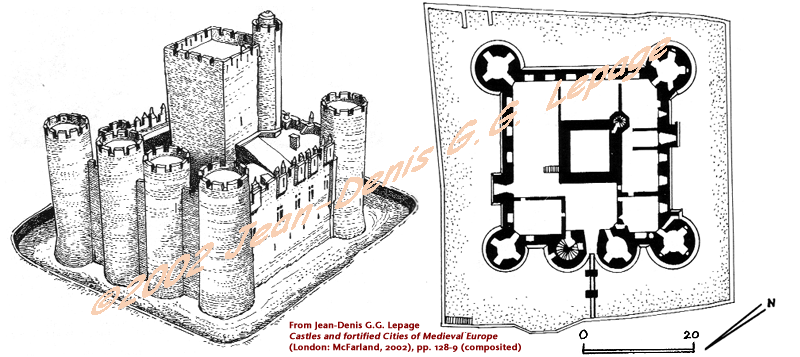
Roquetaillade (pp. 128-9) which includes a typical 12th century square donjon, 13th century round corner towers, but then also round towers on the entrance wall set so close together (the whole castle is only 40m on a side) that it appears more like a row of 20th century concrete grain silos one might see in Kansas (One small word of caution is in order here: the ground plan and rendering do not agree perfectly, so it might be unwise to rely on these for exact details, rather than general features). Further, a good proportion of his castles are not French or English, with many from the Netherlands, Belgium, Iberia, and even Kenya (Fort Jesus in Mombassa, a wonderful example of the export of 16th century trace itallienne design to the colonial setting).
The text of Castles and Fortified Cities begins not with the castles themselves, but rather gives a brief introduction and outline of medieval history, intended to provide the reader with a feeling for why medieval Europeans needed to construct castles
in the first place. The other chapters deal with each broad type of fortification chronologically, breaking the middle ages (10-16th century) into three periods , corresponding to 'primitive' castles, the full stone castle, and responses to artillery. A final, very admirable chapter offers an overview of city plan development from the 12-16th century. Most information on specific castles themselves is confined to the caption to each illustration, but therein is a wealth of information -- probably 1/4 to 1/3 of the text of the volume is in the captions. Lepage has clearly read widely, for there is a mixture of rather generic, common sense information in his text that seems to derive from visits to many of these places, as well as details of people, places, and events that suggest that he knows more than just the stones -- take for example, mention of specific castle architects in England or France, lists of early battles in which gunpowder played a role, or simply the remarkably broad range of examples he can muster when discussing sieges, urban development, or conflicts between various factions (e.g., the Crusades).
Lepage is an admirable illustrator and adds numerous new types of illustrations to this study. Much like David Macaulay (author of classic illustrated books like Castle, Pyramid, Cathedral, and his prescient archaeological farce, Motel of the Mysteries), Lepage excels at providing clear, uncluttered images of activities fundamental to castle and military operations. He provides the expected renderings of "a knight", "a siege", "an archer", and the trebuchet (with a nice diagram of how it fires), but then also adds schematics of how spiral staircases are built, a cutaway of hoarding, plan and section of bossage (masonry facing styles), town plans, and lesser-known construction elements (like chaguettes, sentry-box projections from curtain walls). Here Lepage resorts to very generic illustration, placing, for example, a raft of weapons -- axes, bed du corbins, maces, flails, daggers -- from different times and places (and some 19th century versions) together as "various medieval offensive
weapons." But of course, this is a book on castles, not weapons, but that sort of generalizing does pervade the book. In most cases, the realistic illustrations include a soldier or two, but interestingly -- and to his credit -- for a book that might be targeted at a juvenile audience, he draws a number of soldiers "down" in the siege scenes. Many authors on fortifications will describe the development of artillery fortifications; some will give plans and sections of casemates; Lepage adds soldiers firing from within the casemate and shows how smoke vents tried to keep the subterranean areas clear (p. 206). Generally, he is very good with cutaways and illustrations with layers removed, although at times, his pen records only impressionistic details, while the scholar might want more. Some illustrations seem to have distorted perspective, especially in the aerial views of bastioned forts where the compound angles themselves are tricky -- but overall these do not distract too much from the illustrations.
So visually, this book in many ways surpasses Toy's classic, but at nearly 10 times the price it is not at all clear that the cost-benefit analysis comes out in its favor. Textually, the book is a good read, but certainly does not try to compete with more established classics in the field. Unfortunately, given the realities of library acquisitions budgets these days, even the public, primary, and secondary education libraries may not choose to afford this book. And universities may pass on it as well, as at first glance it might be possible to have the word 'juvenile' inform one's impression of the book, but even if you aren't willing to invest in your own copy of this book, you may wish to turn to it for good, if generic illustration material.

Steven A. Walton
Penn State University <[email protected]>
Page Added: July 2003